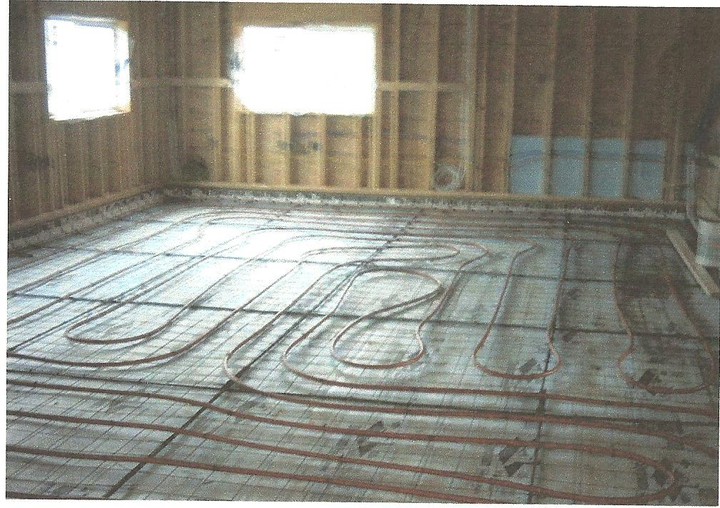
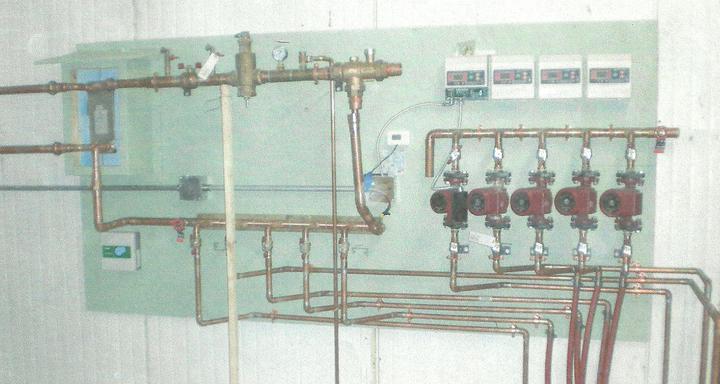
You have to do a really, really good job with your rough grade under ridgid foam. If you don't the foam will bridge and leave pockets, which will lead to cracks in your floor. There are products out there that are like concrete blankets that will follow any uneveness in your rough grade to support your floor better. I have seen instances where styrofoam was used, and very heavy point loads were in floors, (town hyw. plow trucks loaded with sand and heavy plows, that colapsed the styrofoam under the concrete. You also need to pay perticular attention to floor drains, and how you route your radiant tubeing AROUND them. You don't need an extreamly high R value under the floor, but it does need to have a very good vapor barrier. Moisture will wick away the heat without good vapor protection. I am a retired contractor and built a good number of Ag and comercial steel buildings with radiant heat in them. Also make sure you isolate the aprons with a vertical frost barier protruding to finish level, between floor and aprons, and string the tubing closer together in front of overhead doors. A good R 10+ vertical frost barier at least 2' deep, around the perimiter of the building is also necessary. We used 2" ridgid styrofoam there. The tubeing in the pics is 7/8" supplied by Radiant Tech Inc., Lyndonville VT., who designed and provided materials and controls for our heating systems. Loren, the Acg.
Upload one or more videos to your post. Photo filesizes should be less than 300K and Videos, less than 2MB. Formats allowed are gif, jpg, png, ogg, mp4, mov, and avi. Be sure to use filenames without spaces or special characters, and filetypes of 3 digits lower case.
We sell tractor parts! We have the parts you need to repair your tractor - the right parts. Our low prices and years of research make us your best choice when you need parts. Shop Online Today. [ About Us ]
Today's Featured Article - Women and Tractors - Tractor Engine Repair - by Teri Burkholder. One of the great things about working on a tractor engine with your other half is that you know what he is thinking of at all times and can anticipate his every move and his next thought of what he will do. With Ben, anyway, I can tell! He'll be busy working and I�m handing him tools and he says, "give me that..." and I�ve already got it in his hand or "hand me that....."and I�ve got the portable light right where he needed it placed to see. "Run in the house and get me a...."as I open th
... [Read Article]
Latest Ad:
1965 International Harvester McCormick Farmall cub tractor 2,500. Two owner tractor. My grandfather bought new in 1966, then we inherited it. Have all the paperwork original manual and all maintenance records. It starts and moves. Comes with underbelly mower, plough, and some other attachments.
[More Ads]
All Rights Reserved. Reproduction of any part of this website, including design and content, without written permission is strictly prohibited. Trade Marks and Trade Names contained and used in this Website are those of others, and are used in this Website in a descriptive sense to refer to the products of others. Use of this Web site constitutes acceptance of our User Agreement and Privacy Policy
TRADEMARK DISCLAIMER: Tradenames and Trademarks referred to within Yesterday's Tractor Co. products and within the Yesterday's Tractor Co. websites are the property of their respective trademark holders. None of these trademark holders are affiliated with Yesterday's Tractor Co., our products, or our website nor are we sponsored by them. John Deere and its logos are the registered trademarks of the John Deere Corporation. Agco, Agco Allis, White, Massey Ferguson and their logos are the registered trademarks of AGCO Corporation. Case, Case-IH, Farmall, International Harvester, New Holland and their logos are registered trademarks of CNH Global N.V.